Tech

New Products

Random Thoughts

Nostalgia

Showing posts with label New Products. Show all posts

Remember Red Crown Valve Stem Caps...?

Posted on 6/5/18 with No comments

Hardly anyone today, remembers full service where they pumped your gasoline, washed your windshield, checked your oil, and the air in your tires. It was the same at most any gasoline station with one exception. At the local Standard Oil Gasoline Station, if you needed air they added it at no charge and put a set of these valve stem caps on to let the world know that you bought gasoline at the local Standard Oil Station. You got Red Crown valve caps if you bought regular gasoline or Gold Crown valve stems caps if you bought premium gasoline.


The "Red Crowns" were a reminder of the Red Crown Gasoline they sold. The Red Crown Caps were a likeness of the glass Red Crown globes on top of the gasoline pumps on the drive. The Red Crown was by far the most popular grade of gasoline they offered.  Red Crown gasoline was introduced sometime around 1914 along with White Crown (premium) gasoline which would become Gold Crown premium gasoline in 1951.


The Red Crown valve caps were nothing short of advertising genius. For just pennies the Standard oil dealer could advertise his gasoline on half the cars in town. In addition... if kids rode in on their bicycles they too could get a set of Red Crowns. And you know... as soon as one kid in the neighborhood got'em the rest were soon to follow.  Car owners and kids alike would come by the station to get something for free... just like they still do today. Station owners literally ordered the Red Crown valve stem caps by the hundreds.


The Red Crown Valve Stem caps were introduced sometime in the 1940's and lasted until about 1962. Their popularity was the strongest from about 1955 thru 1962. They introduced the Gold Crown Caps in 1951 to help market the new Gold Crown Gasoline. You seldom saw a set of Gold Crown Valve Stem caps, the Red Crowns always seemed to be more popular, the bright color seemed to be more eye catching.


The good news is both the Red Crown and the Gold Crown valve stem caps are now available in the parts department at Fifth Avenue. They became one of my nostalgia projects because of how popular they once were and the genius marketing idea they represent. It is the detail you need to set your antique vehicle apart from the rest. These are an exact match to the originals.


So a set of the Red Crowns (5) will set you back $10.00. The Gold Crown caps are the same price and also come in sets of (5).  These are the authentic red color of the originals. Postage is included.

If you want to make them look like they have been on your antique vehicle since the 1950's just set them out in the sun for a while the gloss will disappear and they will fade to a dull red and look just like a used set from the 1950's. Life is good !

Meanwhile... Here is more Standard Oil Red Crown gasoline history...


READ MORE

Tag Toppers Available For Your Business, Car Club Or Event...

Posted on 6/1/18 with No comments

I have been collecting license plate tag toppers for close to forty years, and have more than 200 different Tag Toppers in my collection. If you have read my other entry on Tag Toppers you know that I have reproduced some of the original design Tag Toppers with the Fifth Avenue logo for use on the Great Race cars. I also offer them to customers who what an original design auto advertising accessory to display on their antique vehicle. My current 2018 design features a reflectorized background, so it shows up at night.

Meanwhile...Here are a few of my originals....


Example of an early Tag Topper from the late 1940's.


This One Has Some Well Detailed Graphics...


Tag Toppers Came In All Shapes And Sizes...


This One Has Lots Of Detail And Is Porcelain... A Keeper.
                    

Example Of An Early "Downer" Tag Topper


This one was designed to go behind the chrome bezel of the trunk handle.

Tag Toppers are still a very effective way to advertise as I found out in 1993 when the car I sponsored in the Great Race won the Great Race Sportsman class and the driver Howard Sharp earned a 10 minute interview on national television.


    My first Tag Topper Design That Ended up on ESPN TV.

Howard Sharp the car owner did a sit down interview in front of his car with an ESPN reporter, and my tag topper was proudly on display attached to the front license plate bracket of his 1929 Dodge Sport Roadster, with my business name and phone number proudly on display! I got free advertising on national TV for ten minutes, and all I had invested was the cost of that tag topper. As I was watching I was thinking to my self... that tag topper was a dang good investment!


Howard now enters this 1915 Hudson in the Great Race with is son Douglas. Howard went on to win the Great Race twice more, in 2011 and again in 2015. I have sponsored Howard in the Great Race every year for more than 25 years and we have become good friends.


The Willys Overland Jeepster Club designed these and each of their 400 members in good standing got one in honor of the clubs 50th anniversary.

I often get asked if I can make custom Tag Toppers for car clubs, other businesses, and special events. The answer is yes, and have been making them off and on for about ten years but have not formally offered the service. But I am getting enough requests that I decided to explain the process and outline the options so if you want to have some made you will have some idea what is involved.

First up is the blanks. They are made of 20 thousandths thick aluminum (same thickness as an interstate road sign) so they are very durable and they will not rust.

As for the colors... you can use most any combination of up to five different ink colors, in addition to any background color so you could end up with six different colors  on a Tag Topper.  My current Tag Topper has 4 colors, Green, White, Red, Black, and the background color of yellow for a total of five colors.

Along with the colors you can screen the background to lighten a color to highlight a detail. The light green color in the background of my logo, is the same dark green color behind my telephone number. It has simple been screen down to thirty percent to give my logo some depth.  The black is also screened for the grill and front bumper.

Reverse type is also available, which is what I have done on the Fifth Avenue Tag Topper to draw attention to the telephone number.

Bleed to the edge... simply means that the background color can be printed out to the very edge of the Tag Topper and a non print boarder area is not necessary.


An example of reverse lettering on an early Tag Topper


Some Tag Toppers Were Even Embossed...

We can add most any logo or graphic along with most any lettering style. A lesson from the billboard company... simple is good and if you select a light colored background such as yellow or white, you should select a dark color of ink such as a black, dark brown, red or dark green. The better the contrast the more eye catching it will be.

We also offer a reflectorized background just like a modern road sign so your tag topper will show up at night. The Fifth Avenue Tag Topper examples shown at the top of the page are reflectorized.

Think about road signs, a stop sign for example, red background, white lettering. the colors catch your eyes and the message is easy to read from a distance. And once you have seen it you immediately recognize it again.


This is an example of a well designed Tag Topper. Notice the bright contrasting colors, the simple message and the logo. This one is easy to read from a distance and it is very eye catching!

The billboard people say an average driver has just 7 seconds to read an entire billboard message at 60 mph. that is why most billboards have a short simple message and a graphic to catch your eye.

The advantage to a Tag Topper is that while it is smaller in size than a billboard it will likely be in front of the car following you for a lot longer than seven seconds. And because antique vehicles tend to travel slower than their modern counterparts, you pretty much have a captive audience.


Uppers and Downers...refers to the mounting of the Tag Topper, it can be mounted to the top of a license plate or license plate bracket such as the one on a gravel pan behind the front bumper or the tag topper can be designed to mount hanging down such as on the headlight bar of a Model A Ford.


I use Tag Toppers to identify the cars I have prepared for the Great Race. This one is on a 1936 Ford police car.

A tag topper will usually mount to the front of modern cars and trucks, either as uppers or downers.

All of the ink used on Fifth Avenue Tag Toppers is UV resistant and fade resistant and is the same ink they use on interstate road signs.

That means you can power wash your tag topper at the car wash to get the bugs off without worrying about the ink coming off with it. All of the Fifth Avenue Tag Toppers have passed the Kansas June Bug Test... where you hit a Kansas June bug a 70 mph and there is no damage your tag topper. Sorry...we can't same the same for the June bug.

And last but not least the Fifth Avenue Tag Toppers are made in the USA by the same company that was established in 1946 to make what else...Tag Toppers identifying volunteer fire department members. That same company today, makes all kinds of graphics for fire trucks, ambulances, and rescue vehicles, police cars and the like.

They have kept up with technology and that is why we are able to offer multi-colored Tag Toppers, although they did not apply that technology to Tag Toppers until I showed up on their doorstep. They mainly use the multi-colored graphics on the firetruck, ambulance, and rescue vehicle graphic projects. I was happy to expand their horizons.

I worked in graphic arts for 20 years before I started Fifth Avenue, so I am able to design and layout all of my own books, catalogs, and advertising. I knew how to design tag toppers but I wanted authentic ones from a company who was established when tag toppers were popular. I also wanted them to be USA made.

I finally found a company and we compared notes and we are on the same page. Now here we are some ten years later and I am still making custom tag toppers. I do it for the fun of it, to keep a part of automotive advertising history alive. Some things you do for the fun of it, not the money. And the Tag Toppers I create today will be collectible in later years just as the originals are today.

A Tag Topper is a period correct automotive advertising accessory that is just as effective today as when they were popular in the the 1940's and 1950's.

So if you are interested in a custom tag topper for your business, a car club, or event drop me an email at fifthavegarage@gmail.com and show me what you have in mind. I will help you figure out and a design that will result in a good looking tag topper than you will be proud of. Below are some of the more popular ones I have done in the past.


READ MORE

Cooling System Clean Out - What To Use And How To Do It.

Posted on 10/19/17 with No comments

Removing the rust, scale, and hard water deposits from the inside of a cooling system can be a challenge. Most of the antique vehicles we drive are at least fifty years old.

Depending on where the previous owners lived, the cooling system was filled with well water, tap water, water from a farm pond, or from a hydrant, but seldom was distilled water used (water with the minerals removed).  So with all of those minerals floating around and attaching themselves to the inside of the cooling system, then being baked on in numerous heat cycles, it is no wonder the inside of the cooling system looks like it does.

Not only does the rust, scale, and hard water deposits reduce the overall capacity of your cooling system, it also restricts the flow of coolant thru the radiator core and the water passages inside of the engine block. When their becomes enough of a buildup, you start to have overheating problems, not just in town but on the highway. That is your first clue the cooling system needs attention.

If you have any doubts about how clean your cooling system is on the inside, simply remove the radiator cap (engine cool) and have a look inside. What do you see? Does the underside of the cap look like... the radiator on the left or the radiator on the right...?


Now look down a little further at the top of the radiator core...is their is rust and hard water deposits around the tubes? If there is rust , scale, and corrosion in the radiator, what do you think the inside of the engine block looks like?


So...just removing the radiator and taking it to the local radiator shop for a good cleaning is not the answer. While it may help, you can bet that if the radiator is full of rust and corrosion, the engine block is the same. You need to clean out the whole system to fix your problem.

I have tried about all of the cooling system products over the past 25 years as I prepare the cars entered in the Great Race. The cleaners that seemed to work the best were also the most toxic, and were hard on radiator hoses and head gaskets.  So I have always kept looking for something better.

I finally found something better, it is called Thermocure. It is non toxic, non corrosive, more than does the job, even for some pretty nasty cooling systems. Best of all it is manufactured in the USA!

Here is how it works. You first need to drain your cooling system, including the radiator and engine block. Be sure to dispose of the old coolant properly as it is toxic to pets.

Next up... close all of the petcocks and add the 32 oz bottle of Thermocure, and then refill the cooling system back up with clean tap water to the level shown in your owners manual.

Now go drive your vehicle. The Thermocure needs to circulate thru the entire cooling system a minimum of four hours, at full engine operating temperature. If your cooling system is really dirty inside and has not been cleaned in a long time, drive your antique vehicle more. Like two weeks... or a months worth, every day. Remember it took years for the cooling system to get this dirty so it will take a while to get the inside clean again.

Your car will not overheat with the Thermocure but it WILL freeze... as you have no antifreeze in the cooling system. In some cases, I have had customers drive every day for six weeks, with the Thermocure in the system. It will not hurt anything, and the longer the Thermocure is in there, the more gunk that will get cleaned out.

Then it is time to drain the cooling system once again. Be prepared... depending on how dirty your cooling system is, the stuff coming out of the engine block and radiator will be a brown or even a black, rust colored sludge. When you get everything all drained out, flush out the entire cooling system with clean tap water. You will want to do this from both directions top down, and from the bottom up.

Next refill the cooling system with clean tap water and get it up to operating temperature for an hour or more, then drain the cooling system again. What comes out should be a little more clear in color. Keep repeating the process until you get clear coolant from the radiator and engine block.


Here are some samples from a really dirty cooling system. The car had been in storage 30 years. The cooling system was in need of a good cleaning BEFORE it was parked.

The first jar on the left was the first drain with the Theromcure installed, after the car driven everyday for about a six weeks. The second jar was the first drive and flush. The third jar was yet another drive and flush. And finally the last drive and flush jar came out clean. A lot of difference from the first jar.

So...you may have to repeat this flushing process a few times until what you get coming out is clear. It will be worth it. You will end up with a like new cooling system and the operating temperature will drop 20 to 30 degrees. In a few extreme cases I have used a second bottle of Thermocure if the first two drain and flushes did not start to come out cleaner.


After you are done with the cleaning process it is a good time to replace the thermostat while you have things apart. Replacing coolant hoses is also a good idea. Check for leaks around freeze plugs and the rest of your cooling system, and you should be good to go.
                                                 

Refill your cooling system with a 50/50 mix of distilled water (you do not want to put the minerals back in that you just worked so hard to remove) and antifreeze. You can buy premixed antifreeze and the local auto parts store and most discount chain stores.


You can buy 50/50 antifreeze already premixed


Most all of the popular brands have it available.


One 32oz bottle of Thermocure will clean up to a three gallon cooling system. If your cooling system is bigger, order two bottles. If your cooling system is really dirty you can order two bottles and give your cooling system a second treatment.  It will be time and money well spent.

You can order Thermocure in the "Parts" section of the website under "Cooling".


READ MORE

Bluetooth For Your Antique Vehicle And Daily Driver

Posted on 7/3/17 with No comments


Finally...A Simple Bluetooth Adapter That Works...

Most of us enjoy music while we are driving our antique vehicles. Many of us have downloaded music onto our smart phones or use a music app like the Sirius XM App or other music source.

All is good until you get into a vehicle that is not bluetooth capable... then what. You can't play your music thru your in dash car radio and if the cell phone rings you have to be careful where you answer it... if your city is one that requires hands free telephone communications.

If you have called Fifth Avenue and talked to me on the telephone one of the things I always remind you..."Simple is Good!"

So when I went looking for a Bluetooth adapter device here is what I wanted...

1) Simple to install and program.

2) Would work for hands free telephone calls, both receiving and sending. (that means it had to have a built in speaker) About half of the adapters I looked at, did not have a speaker built-in.

3) Required no batteries. Many of the adapters I looked at required batteries of one size or another, and many of the other ones that went into the cigarette lighter socket offered no way to recharge your cell phone. I wanted to be able to use a Bluetooth adapter AND recharge my cell phone from the same source.

4) Use my original radio controls for volume control. Once the Bluetooth adapter was turned on...I wanted to control the volume and radio setting from my in dash radio.

5) Had to be simple to switch from music to phone calls and back.


It does not get any more simple than this...

Here is what I found that works the best by far. This device plugs in your 12-volt cigarette lighter which powers the adapter. In turn the adapter has a USB port to recharge your phone so you do not loose the ability to recharge your phone while using the Bluetooth adapter.

This device has a speaker built-in so your telephone conversations will be hands-free. You can advance to the next song or go back to a previous song with the push of a button.

To answer the telephone just push the button in the center, and to hang up push the same button. When the telephone conversation is done it will automatically switch back to the music mode.

It comes with simple instructions to show you how to "pair" your smart phone. The little short cable goes into the "Aux" connection on your in dash radio. The rest simply plugs into your cigarette lighter, which makes it portable so you can use it in your daily driver during the week and in your antique vehicle, camper, boat, motorcycle on the weekends.


Aux Extension Cable is Included

In case you are doing a motorcycle installation or some other application where the aux radio input is hidden or difficult to reach, an extension cable is also included so everything reaches. You can drill a 1/4 hole as per instructions and add a permanent easy access aux input or keep things portable.

Best of all the price is right at $65.00 each plus shipping. It has a one year warranty. I have been using one of these for about six months now and they work as designed. The cell phone conversations are clear, and the radio sound is also clear, and with satellite radio you don't have to listen to all of the commercials. These are now available in the parts section of the website. Enjoy!

Attention Honda Gold Wing Owners...

If you own a Honda Gold Wing, especially the 1800 model, you no doubt have wondered why Honda did not update the 1800 radio to Bluetooth? Well this bluetooth adapter has proven to be a simple fix. You can listen to satellite Radio, or the music down loaded on your cell phone AND you can have hands free cell phone calls. The long cable included with this adapter will easily adapt to the Honda AUX cord. You can then make a permanent easy access Aux input location and life will be good.

Best of all this Bluetooth adapter is not permanent so you can easily move it from vehicle to vehicle and lock it in you saddle bag at night for security. All of us that ride together now have Bluetooth. Life is good!


READ MORE

Fuel Bypass System...The Simple Way VS The Hard Way

Posted on 5/18/17 with No comments

By now most of us have had first hand experience using modern gasoline in our antique vehicles. We know from experience that the gasoline we buy today is not near the quality the gasoline was when out antique vehicles were new. If you have read my book "The Official Guide To Modern Gasoline And Oil for Modern Vehicles"... you know why that a quality gear driven electric fuel pump with the same working pressure as your mechanical fuel pump is almost a necessity.


This is our 92 series electric fuel pump taken apart so you can see how it is made...


A 30 micron fuel filter is included with every 92 series electric fuel pump

One other thing the modern fuel systems do is circulate the gasoline between the fuel tank and the fuel pump via a return line. This helps keep the gasoline cool, keeps the gasoline from turning to vapor and blocking the flow of fresh gasoline to the carburetor (in our case), and any extra volume of gasoline can be returned to the fuel tank.

Ok...fine you say, "but how am I supposed to make the fuel circulate in my antique vehicle fuel system...?" There are a couple of way to do it but at Fifth Avenue we believe "simple is good!" I have prepared cars for the Great Race for close to thirty years now, and the one thing I always find interesting is how a group of 100 antique vehicle owners can come up with so many complicated solutions to a simple problem. Building a recirculating fuel system is a good example.


                            You could do it the hard way like this...

This solution, while good in theory makes the job a lot more difficult that it has to be... and there are a few flaws in this design. In this example the by-pass portion of the fuel system that is closest to the underside of the car ...those 90 degree elbows will prove to be a restriction to the fuel flow as will the check valve installed in the fuel line, and we all know from experience, the more joints there are...the more places you can expect to have a leak. It is just Murphy's Law.


Or you could accomplish the same thing using this...

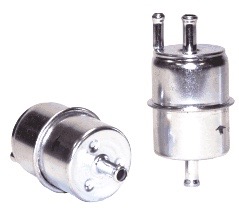
This is the simple solution. This is a special application fuel filter that works with our 92 series electric fuel pump. This special application fuel filter has 5/16"  inlet and outlets, so it will work in the same fuel line you are using now. It has an extra 1/4" outlet so you can run a 1/4" return fuel line back to the fuel tank to circulate the fuel. You want to install it on the output side of the electric fuel pump. It is a simple installation and do not have to add a bunch of plumbing to complete your mission.

I know what you are thinking...but this filter needs to go AFTER the electric fuel pump so the electric fuel pump can help push the fuel thru the system. If you put this filter before the electric fuel pump it will be difficult for the electric fuel pump to circulate the fuel. With the alcohol in the gasoline today you can not have too many fuel filters... Simple is Good!

This filter is part number 17415DOF and is available in the Parts section of the website.


ONE MORE THING...as Lt. Colombo used to say, this concerns check valves in fuel systems.


Example Of An In line Fuel Check Valve

You might be thinking about adding a fuel system check valve like this one in your fuel line to prevent vapor lock. While that might sound good in theory if you understand how a mechanical fuel pump works and how a carburetor works then you will know that is NOT the answer to your problem.

A mechanical fuel pump works (in simple terms) with two valves, one on the inlet and one on the outlet. The inlet valve opens to draw fuel in using the vacuum created from the diaphragm. Then the inlet valve closes and the outlet valve opens and the fuel is forced out the outlet side of the fuel pump to the carburetor. If one valve is open the other valve is closed.

What this means is...there will always be one valve closed in your mechanical fuel pump, so there is not much chance of fuel draining back to the tank thru the mechanical fuel pump. The same thing happens in the carburetor. The fuel travels into the inlet of the carburetor and the fuel bowl fills with fuel. Once the fuel bowl is full the needle and seat close off the incoming fuel supply thus preventing the fuel from draining back into the fuel line. It works that way (at least in theory) so there is always enough fuel in the carburetor to start your antique vehicle. So there is not much chance for the fuel to leak back towards the fuel tank from the carburetor either.

SO...Where does your fuel go and how come your car takes so long to start after it sits for a week in the garage...?

One of two things is going on. In most cases the fuel in the carburetor is simply evaporating. Modern fuel has a low boiling point to help with emission standards, which is fine for modern cars with high fuel pump pressures. It is not fine for our antique vehicles that have four pounds of fuel pump pressure or less.  So a simple explanation is the fuel simply evaporated out of the carburetor while your car was parked,  most likely out the air horn vent.

The second thing that happens is that the fuel turns to a vapor while in the fuel line. This is common if the fuel line runs next to an exhaust or if there is a lot of heat under the hood from exhaust headers (for example) which will help speed up the evaporation process. That under hood heat will also boil the fuel out of the bowl of the carburetor as well.

When the fuel turns to vapor in the fuel line it will expand and block the flow of fresh gasoline to the mechanical fuel pump. This is common after you have driven you antique vehicle for an hour or so then shut it off.  The heat soak from the exhaust manifolds and it being a 90 plus degree day will help the problem along and make it worse.

The fix of course is an electric fuel pump mounted back close to the tank so it can force the fuel to the front. Most always... the vapor lock will occur between the fuel tank and the mechanical fuel pump. The mechanical fuel pump simply cannot pump the fuel after it has turned into a vapor.

Besides an electric fuel pump and the dual outlet fuel filter shown above you also need to add a pint of diesel fuel to every ten gallons of gasoline. It will do two things. First it will raise the boiling point of the gasoline so it will not vaporize so easily, and the diesel fuel will lubricate the gaskets in the carburetor to keep them from shrinking. (the alcohol in modern gasoline will dry carburetor gaskets out causing them to shrink)

So now that you understand how your fuel system works and what is causing your vapor lock, you understand that adding a check valve into the fuel line going to the carburetor will NOT solve your vapor lock problem...and more important you also know why.

READ MORE

Latest

About Me

My photo
Since 1987, Fifth Avenue owner, Randy Rundle, has been making antique, classic and special interest vehicles more reliable and fun to drive.